How a Regional Insurance Broker Cut Document Processing Time by 70% with AI
A mid-size insurance brokerage was spending three full-time staff on manual certificate of insurance processing. Here is what changed when we automated the routine 80%.
When I first sat down with the operations manager at a mid-size insurance brokerage in the Southeast, she did not open with a technology problem. She opened with a staffing problem.
"We have three people whose entire job is reading emails and copying information into our system," she said. "They are good people. They work hard. But I cannot justify hiring a fourth, and I also cannot justify asking them to keep doing this for the next ten years."
The brokerage handled commercial lines for small and mid-size businesses: general liability, workers' comp, property. Every day, dozens of certificate of insurance requests came in by email, each one requiring a staff member to open the attachment, read the coverage details, cross-reference the client record, and manually enter the relevant data into their agency management system.
It was not glamorous work. It was not complicated work. But it was slow, error-prone, and completely dependent on human attention.
What We Found in the Assessment
Before recommending anything, we spent two weeks mapping the actual workflow. Not the workflow as described in the employee handbook, but the real one, with all the workarounds and exceptions that accumulate over years of doing things a certain way.
First, roughly 80% of the incoming requests followed the same pattern. Same fields, same format, same sequence of steps. The variation that existed was mostly cosmetic: different email subjects, different attachment names, slightly different certificate layouts depending on the issuing carrier.
Second, the error rate on manual entry was higher than anyone had acknowledged. A spot audit of 200 records found data mismatches in about 14% of them: wrong policy numbers, transposed dates, missing endorsement codes. None of these had caused a claim dispute yet, but the exposure was real.
Third, the team had no visibility into the queue. Requests were sitting in a shared inbox with no prioritization, no aging alerts, and no way to know which ones had been touched and which ones had not.
The Solution We Built
We did not replace the team. That is worth stating clearly, because it is usually the first fear when AI automation comes up in a conversation.
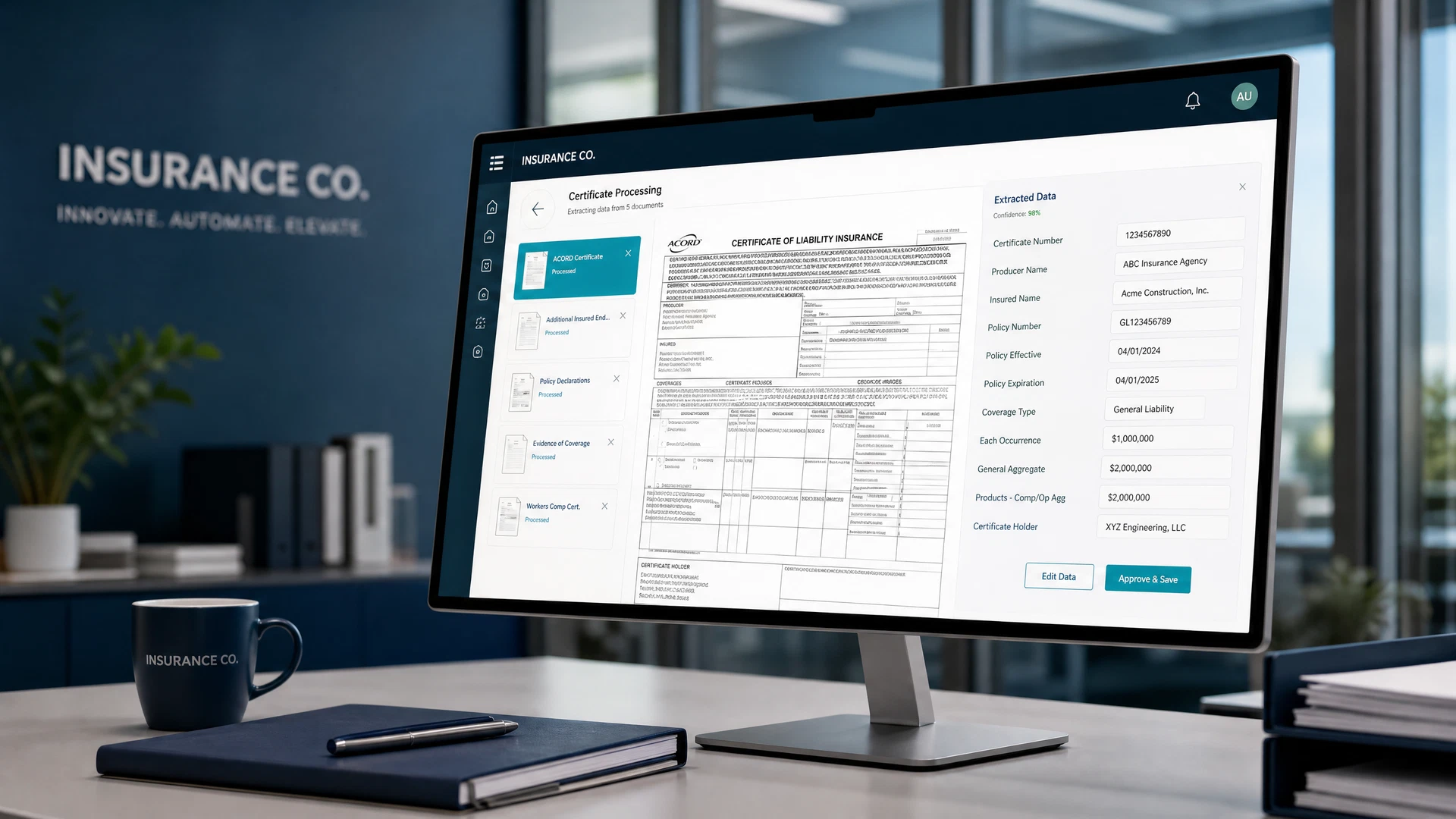
What we built was a document processing pipeline that handled the routine 80% automatically and flagged the remaining 20% for human review. An email monitoring integration watched the shared inbox and triggered on incoming attachments. A document intelligence model extracted the relevant fields from each certificate: insured name, policy number, coverage type, effective and expiration dates, limits, and named additional insureds. A validation layer cross-referenced the extracted data against the existing client record and flagged discrepancies. Matched records were written directly to the agency management system via API. Unmatched or ambiguous records were routed to a review queue with the extracted data pre-filled, so the staff member only needed to confirm or correct rather than re-enter from scratch.
The whole pipeline ran in under 90 seconds per document.
What Changed After Go-Live
Three months after deployment, the numbers were clear enough to share.
Document processing time dropped by 70%. The three-person team that had spent the majority of their day on certificate processing now handled the same volume in roughly two hours, with the rest of their time freed for higher-value work: client follow-ups, renewal prep, exception handling.
The data error rate fell from 14% to under 2%. Most of the remaining errors were in the 20% of documents that still required human review, which was expected.
The operations manager got her fourth headcount, not as a data entry hire, but as a client services coordinator. It was a role the brokerage had been wanting to add for two years but could not justify given the existing workload.
What This Case Study Actually Illustrates
The pattern here is not unique to insurance. I have seen the same dynamic in financial services back offices, in healthcare billing departments, in logistics companies processing freight documents. The work is different on the surface, but the underlying structure is the same: high-volume, repetitive, rule-based document handling that consumes skilled human time and produces avoidable errors.
The AI did not do anything magical. It read documents and filled in fields, the same task a person was doing, but faster and more consistently. The value came from applying that capability to the right process, with the right validation logic, and with a clear handoff protocol for the exceptions.
The team was involved from the start. We did not design the pipeline in isolation and hand it over. The staff who processed certificates every day knew where the edge cases were, which carriers had non-standard formats, and which client records had legacy data issues. That knowledge shaped the validation rules and the exception routing in ways that would have taken months to discover on our own.
We started with the easy 80%, not the hard 20%. It is tempting to try to automate everything. Resisting that temptation and accepting that some documents would always need a human touch made the project faster, cheaper, and more reliable.
We measured before we built. The spot audit of existing records established a baseline that made the post-deployment results meaningful. Without it, the 70% reduction in processing time would have been an estimate. With it, it was a fact.
Is Your Operation Ready for Something Similar?
If your team is spending significant time on repetitive document handling, whether invoices, certificates, applications, reports, or contracts, the question is not whether AI can help. It almost certainly can. The question is whether the process is well-defined enough to automate, and whether the data quality is good enough to trust the output.
That is exactly what a free AI Readiness Audit is designed to assess. We look at your highest-volume manual processes, identify where automation is viable, and give you a written action plan at no cost and with no obligation.
Have a question about this article?
Chat with our team directly on WhatsApp.
Pedro Prado
Founder, Prado AI Solutions. 30+ years in operational risk, audit, and controls. Published author on AI. Trilingual: English, Spanish, Portuguese.